
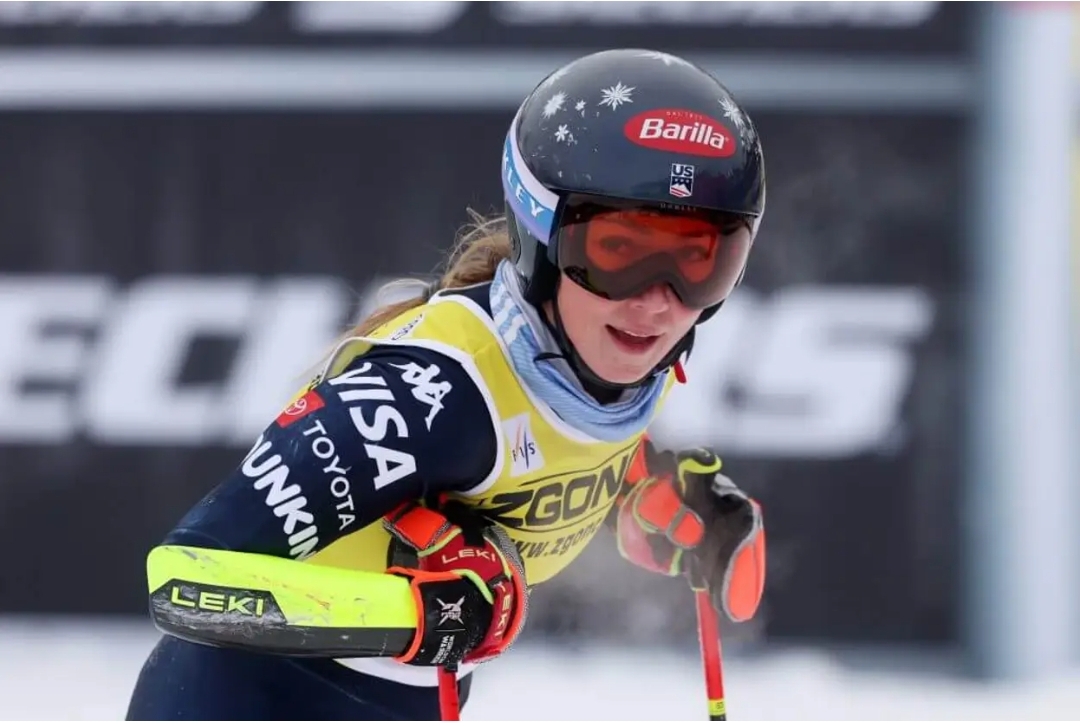
A little more than a year after a terrifying giant slalom crash in Killington that punctured her abdomen and nearly ended her career, Mikaela Shiffrin is finally finding her way back in the discipline that once seemed second nature.
The most successful Alpine skier in history delivered her two best giant slalom results since the injury this weekend in Canada, finishing sixth on Saturday and tying for fourth on Sunday at Mont-Tremblant — just hundredths off the podium on both days.
For almost anyone else, two top-six finishes would be cause for celebration. For Shiffrin — owner of 104 World Cup victories and 22 in giant slalom alone — the bar is stratospheric. Yet after an injury-plagued 2024 season that saw her flirt with finishes outside the top 30, these results represent significant and hard-earned progress.
“It’s just such huge steps,” Shiffrin said after racing. “I don’t really know how to explain what a racket that has been on my brain cells.”
The crash last November tore through her oblique muscles and came perilously close to piercing internal organs. She returned to competition just eight weeks later, but the psychological scars proved deeper than the physical ones. In giant slalom’s aggressive, low stance, her brain repeatedly overrode her body, forcing her to sit back and slow down at the exact moments the sport demands full commitment.
Even this season, after arriving in the best physical shape of her career, Shiffrin placed only 14th in the second GS of the year at Copper Mountain. Rather than panic, she told her team the result felt like a breakthrough — she had finally started to quiet the survival instincts that had been screaming at her for over a year.
A week later in Quebec, the numbers backed up her optimism. Across the four giant slalom races this season, Shiffrin’s finishes read: 4th, 14th, 6th, and tied for 4th. She is now solidly inside the top 15 in the discipline’s World Cup standings and trending upward with the Cortina d’Ampezzo Olympics just nine weeks away.
The comeback has been built on painstaking rehabilitation. Forced to rebuild her core essentially from zero after the injury, Shiffrin and her medical team relearned every movement the correct way, eliminating years of subtle compensations that elite athletes often develop.
“That injury made me grow a whole new set of obliques,” she laughed. “It was grueling, but now everything is stronger and firing in the right order.”
In slalom — the tighter, more upright discipline — Shiffrin has looked like her dominant old self from opening weekend, even winning at Copper Mountain. Giant slalom, with its higher speeds and more extreme angles, has been the final mental hurdle.
To push past the lingering trauma, she has begun training super-G again, deliberately exposing herself to even faster speeds in hopes of making giant slalom feel safer by comparison.
“I still have those pictures flash sometimes,” she admitted, referring to memories of the crash, “but I’m more numb to it now.”
With New Zealand’s Alice Robinson and Austria’s Julia Scheib splitting the four GS victories this season, the podium battle is fierce. Shiffrin, however, is no longer fighting just to stay relevant in the discipline — she is closing in.
“I’m not a podium threat in giant slalom yet,” she said honestly, “but I’m getting closer every week. The goal is absolutely to be contending for medals in Cortina.”
For the skier who has set the standard in Alpine racing for more than a decade, “getting closer” is starting to look a lot like the beginning of another signature comeback.
