
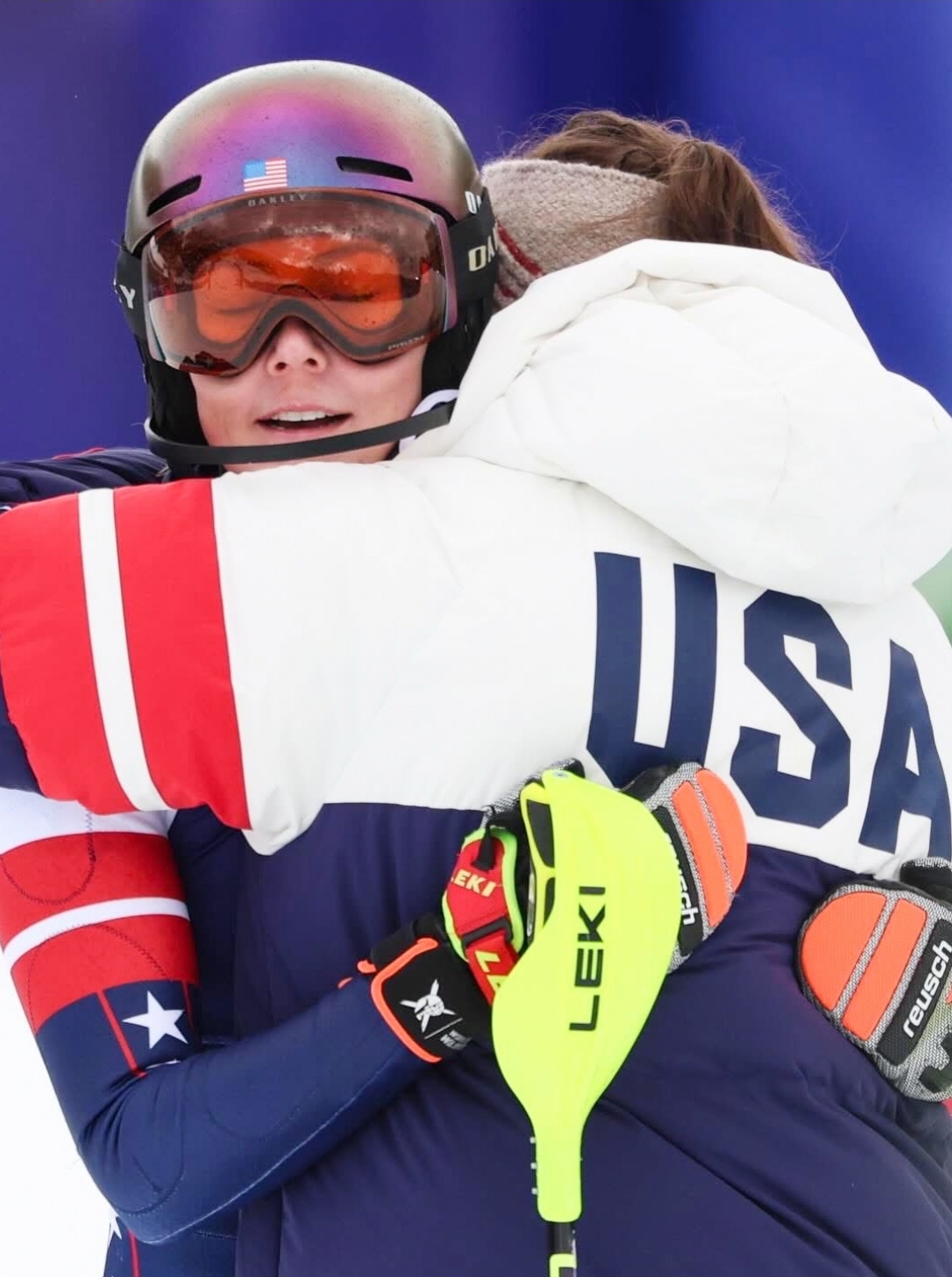
Mikaela Shiffrin’s quest for Olympic redemption hit another roadblock on Tuesday at the Milano Cortina 2026 Winter Olympics, as the American alpine legend finished off the podium once more in the debut women’s team combined event—extending her medal drought to seven straight races.
Meanwhile, Norwegian cross-country sensation Johannes Høsflot Klæbo powered to his seventh career Olympic gold medal with a commanding victory in the men’s sprint classic, moving within striking distance of tying the all-time record for most Winter Olympic golds in his discipline.
Shiffrin, the most decorated alpine skier in World Cup history with a record 108 victories (including 71 in slalom) and two Olympic golds from Sochi 2014 and PyeongChang 2018, paired with downhill specialist Breezy Johnson for the new team combined format—one skier handling the downhill leg, the other the slalom.
Johnson delivered brilliantly in the morning downhill on the Olympia delle Tofane course, posting the fastest time and handing Shiffrin a slim lead of nearly 0.5 seconds heading into the afternoon slalom. Fresh off her individual downhill gold, Johnson skied with confidence despite pre-race concerns over course safety following recent crashes.
But Shiffrin, the slalom queen who has dominated the discipline all season, faltered uncharacteristically. Starting last with the advantage, she skied tentatively, losing time throughout and recording only the 15th-fastest slalom run out of 18 finishers. Her performance dropped the duo to fourth place overall, missing bronze by a heartbreaking 0.06 seconds.
Austria’s Ariane Raedler and Katharina Huber claimed the historic inaugural gold with a combined time of 2:21.66, while Germany’s Kira Weidle-Winkelmann and Emma Aicher took silver by 0.05 seconds. The other American pair, Jackie Wiles and Paula Moltzan, secured bronze—benefiting directly from Shiffrin’s off day.
“I didn’t quite find a comfort level that allows me to produce full speed,” Shiffrin said afterward. “I’ve been so prepared for all the slaloms this year. There’s something to learn from this day, and I’m going to learn it. I want to be careful not to make excuses.”
The result continues Shiffrin’s puzzling Olympic struggles: after golds in slalom (2014) and giant slalom plus combined silver (2018), she went 0-for-6 with multiple DNFs in Beijing 2022. Now, with individual giant slalom and slalom still ahead, the pressure intensifies for the 30-year-old to snap the slump on the biggest stage.
Across the mountains in Tesero, Klæbo continued his march toward history. The 29-year-old Norwegian dominated the men’s sprint classic, securing his second gold of these Games (following the 20km skiathlon) and seventh Olympic title overall—leaving him just one shy of matching compatriots Bjørn Dæhlie, Ole Einar Bjørndalen, and Marit Bjørgen’s record of eight Winter Olympic golds.
Klæbo, already the most successful male cross-country skier in World Cup and World Championship history, finished comfortably ahead of silver medalist Ben Ogden (USA)—who claimed the first U.S. men’s cross-country medal since 1976—and others. With more events remaining, including relays and distance races, Klæbo is poised to potentially become the most decorated men’s Olympic cross-country skier ever.
While Shiffrin faces introspection and a race against time to rediscover her Olympic magic, Klæbo’s relentless pursuit of greatness offers a stark contrast on a day of highs and lows at Milano Cortina 2026.
