
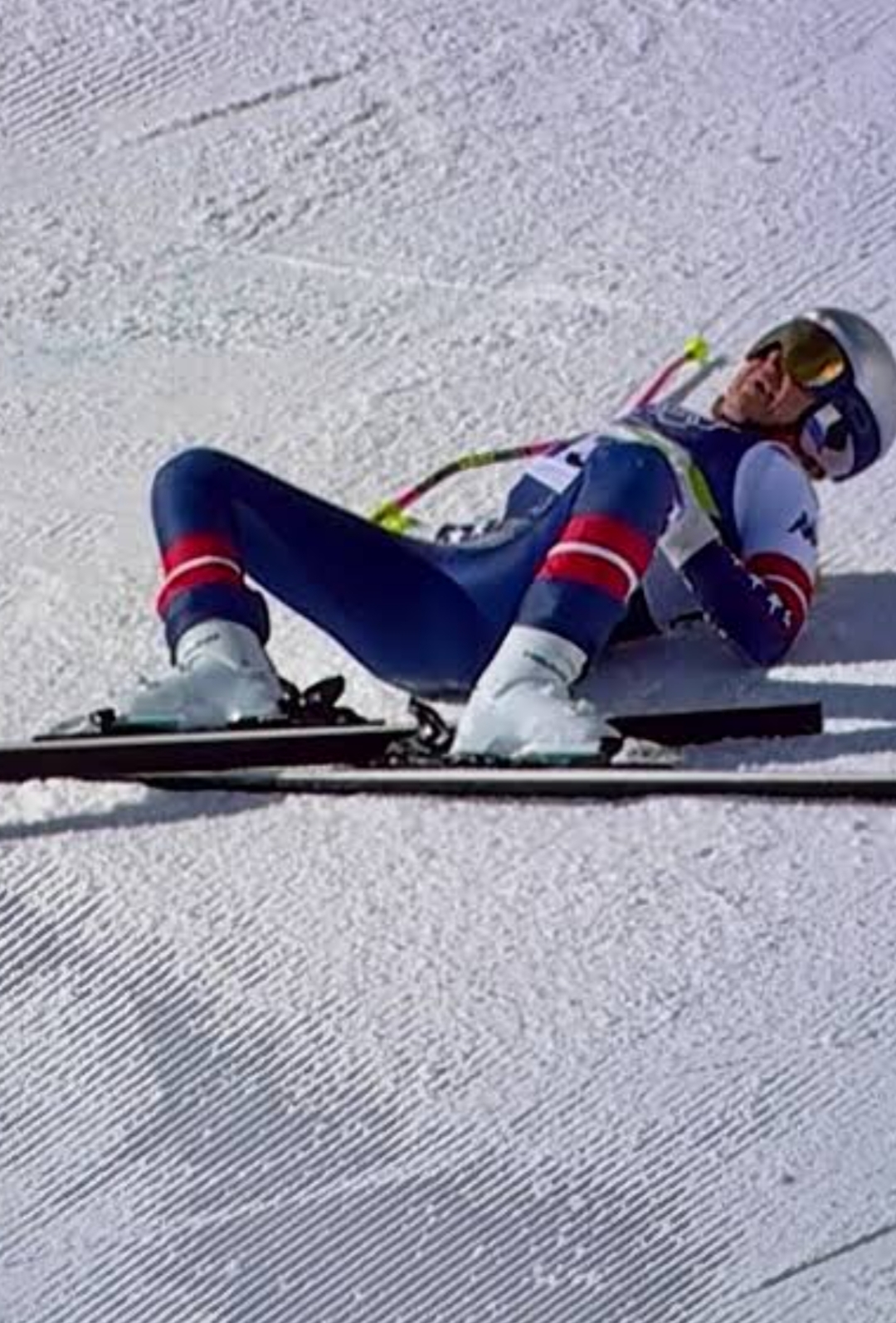
The devastating crash that ended Lindsey Vonn’s 2026 Winter Olympics campaign has reignited urgent discussions within the International Ski and Snowboard Federation (FIS) about advancing ski binding technology to prevent severe lower-leg injuries.
Vonn, the 41-year-old American skiing icon, suffered a complex tibia fracture just 13 seconds into the women’s downhill race on February 8 at Cortina d’Ampezzo, Italy. Racing despite a recently ruptured ACL from a prior World Cup event, she hooked her right arm on a gate, lost control mid-air, and tumbled violently. Critically, her skis failed to release during the pinwheeling fall—her boots remained locked in place as her legs twisted awkwardly, skis pointing in opposite directions while she slid to a painful stop.
The non-release has drawn sharp attention, as traditional mechanical bindings are designed to detach under specific forces like twisting or forward pressure to protect the skier’s knees and legs. In Vonn’s case, experts note the injury stemmed from a rare, high-torque rotational force at relatively low speed—conditions that didn’t trigger the release threshold.
FIS women’s race director Peter Gerdol, speaking to the Associated Press, stated that a so-called “smart binding” system—powered by sensors and algorithms to detect loss of control and automatically release skis—”would have surely” mitigated the severity of Vonn’s fracture. Such technology could dynamically adjust based on real-time data like speed, angle, and force, going beyond the static DIN settings of current bindings.
U.S. Ski and Snowboard Association president and CEO Sophie Goldschmidt echoed the sentiment, emphasizing collective action: “Unfortunately, sometimes it does take horrific accidents to shine even more of a light on what can be done. It’s an area we can’t be competitive in; we’ve all got to be in it together with our different country counterparts and FIS.”
However, officials stress that “smart bindings” remain in the early developmental stage after years of stalled progress due to technical, regulatory, and cost challenges. No timeline exists for widespread adoption, and the sport’s governing body has yet to mandate changes.
Vonn, who has undergone multiple surgeries to stabilize and repair her leg (including an external fixator), has returned home to the U.S. and expressed no regrets about competing. FIS president Johan Eliasch wished her a full recovery, hoping to see her back on skis soon.
The incident underscores downhill skiing’s inherent dangers, where split-second decisions can lead to life-altering consequences. As the alpine community mourns Vonn’s setback while celebrating her courage, the push for smarter, safer equipment gains momentum—potentially saving future athletes from similar fates.
