
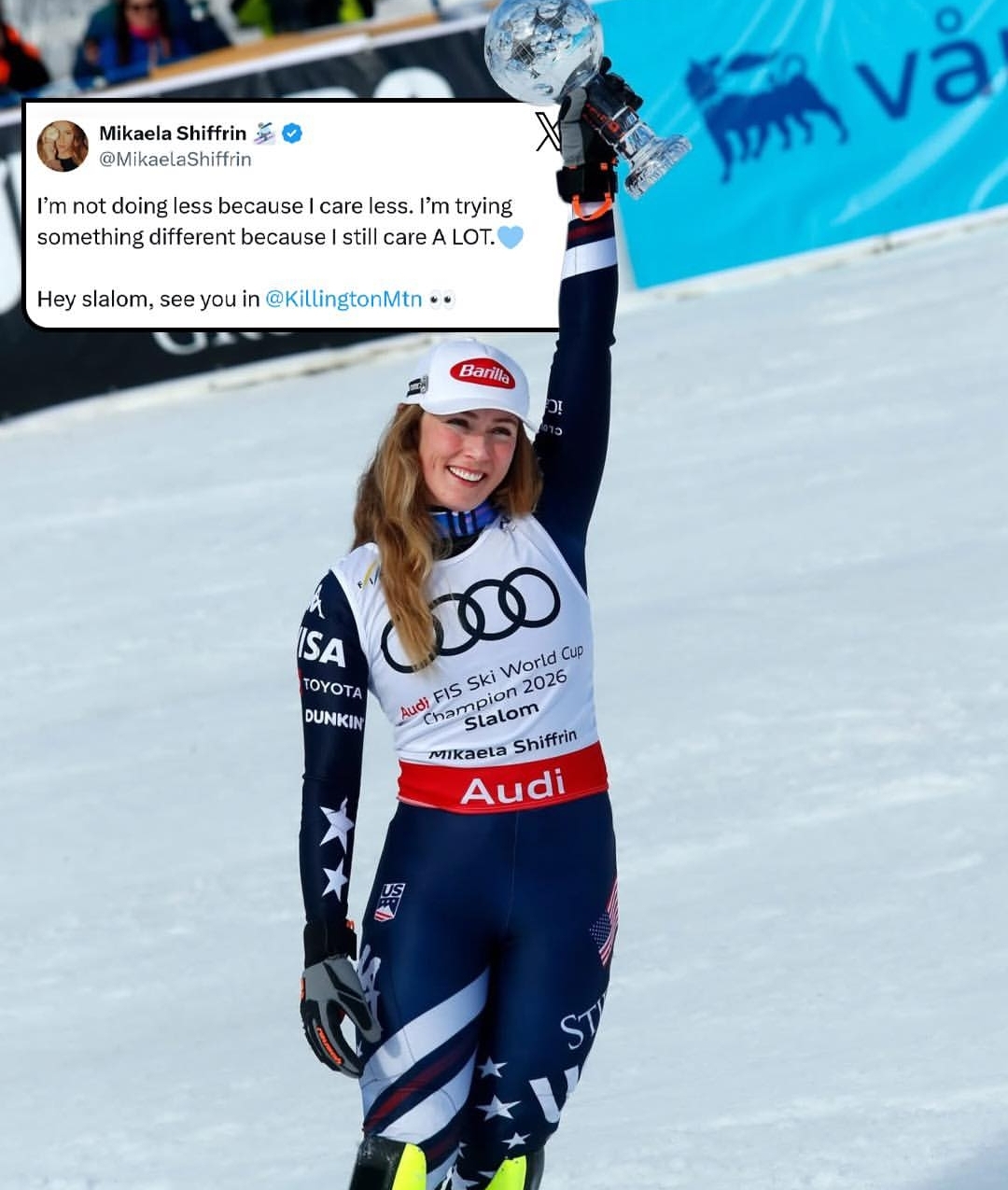
Mikaela Shiffrin is not stepping back. She is stepping sideways — and she wants the sport to understand the difference.
The most decorated slalom skier in history used her podcast, What’s the Point, and a statement this week to lay out a 2026–27 plan she is calling an “exploration season.” After 16 years on the World Cup, nine slalom crystal globes and a second Olympic slalom gold in Milan-Cortina, she will race less of the discipline that made her a household name and put more of her training into giant slalom and super-G.
“I’m not trying to do less because I care less,” she said. “I’m trying something different because I still care a lot.”
The line is the whole argument. Shiffrin is not announcing a wind-down. She is arguing that doing the same thing, at the same volume, for another decade would be the faster road to the exit.
Less slalom, not no slalom
Under the plan she outlined, Killington, Vermont, over Thanksgiving weekend is her first slalom of the winter. She expects to skip the early technical races in Levi and Gurgl, and she has already told fans it will feel strange not to be in the start house at places she has owned for years. More slalom starts remain possible later in the season. The door is open. The calendar is not full.
The World Cup opens on October 24 with a giant slalom in Sölden, Austria. That is where Shiffrin’s winter begins — in the event she now wants the room to chase.
She has not trained slalom at all this offseason. Spring camps at Mammoth and Copper were built around super-G and giant slalom, often alongside the U.S. speed group. Summer training in Chile followed the same shift. The endless precision work that has defined her year, the short-radius turns that beat up the body and occupy the head, has been set aside so longer blocks can go to the faster disciplines.
“When you’re not chasing three, four disciplines, it does give you a lot more ability to focus,” her coach has said of the change.
Why the obvious choice is the risky one
Shiffrin won nine of ten slaloms last season and took a sixth overall crystal globe, finishing 87 points clear of Germany’s Emma Aicher. From a results sheet, the logical move is obvious: protect the specialty, collect the globe, and keep the record chase moving.
She is rejecting that logic on purpose.
“Ironically, the more predictable choice might be to race only slalom,” she said. Staying only where she has been most successful, rather than following curiosity into something less certain, “feels like a faster path toward retirement.”
Slalom, she has said, demands a level of preparation that does not survive half-measures. Racing it underprepared would be, in her words, like jumping into a giant blender and trying to avoid the blades. Cutting the race count is how she keeps the standard, not how she lowers it. She is not looking for less commitment, and she is not looking for less effort. She still wants to ski fast. She still feels competitive. What she wants is permission to be curious about where that ambition goes.
The joy, she keeps saying, was never the medals. It was the process: figuring out a turn, staying with something that is not working until it is. Right now that itch is in giant slalom and super-G. She already has 22 World Cup giant slalom wins and crystal globes across the speed and technical events. The exploration is not a beginner’s project. It is a champion asking what is still left to get better at.
Room to stay
The practical gains are real. Fewer early-season slaloms mean more time at home, cleaner recovery blocks, and training that is not split three ways. Shiffrin has framed the shift as creating room to keep doing the thing she loves a bit longer, rather than stepping away from it.
She knows the narrative that will follow a missed Levi or a quiet November: that the greatest slalom skier ever is done with the event that built her. She answered it before the season started. This is not care fading. It is care changing shape.
The winter will test whether the bet holds. Sölden arrives in just over two weeks. Killington is the first time the slalom world gets her back. Everything between those two starts is the experiment she asked for — not less of a career, but a different way of keeping one.
